
 TSX.V: KSM
 FWB: V0O
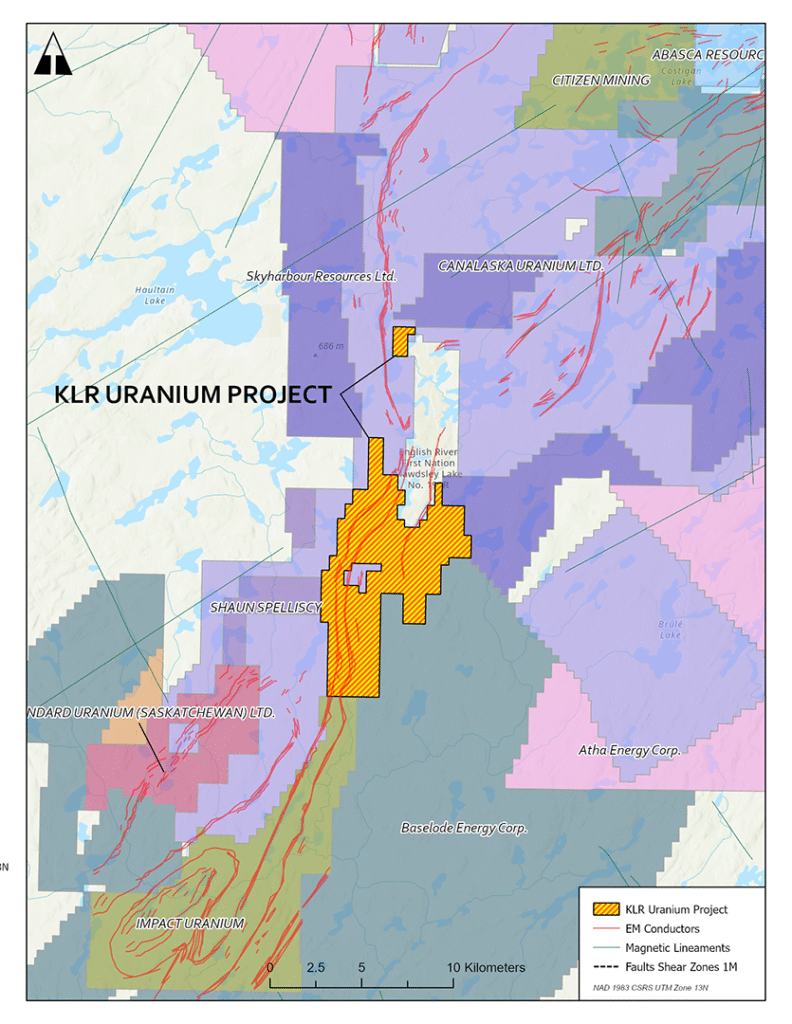
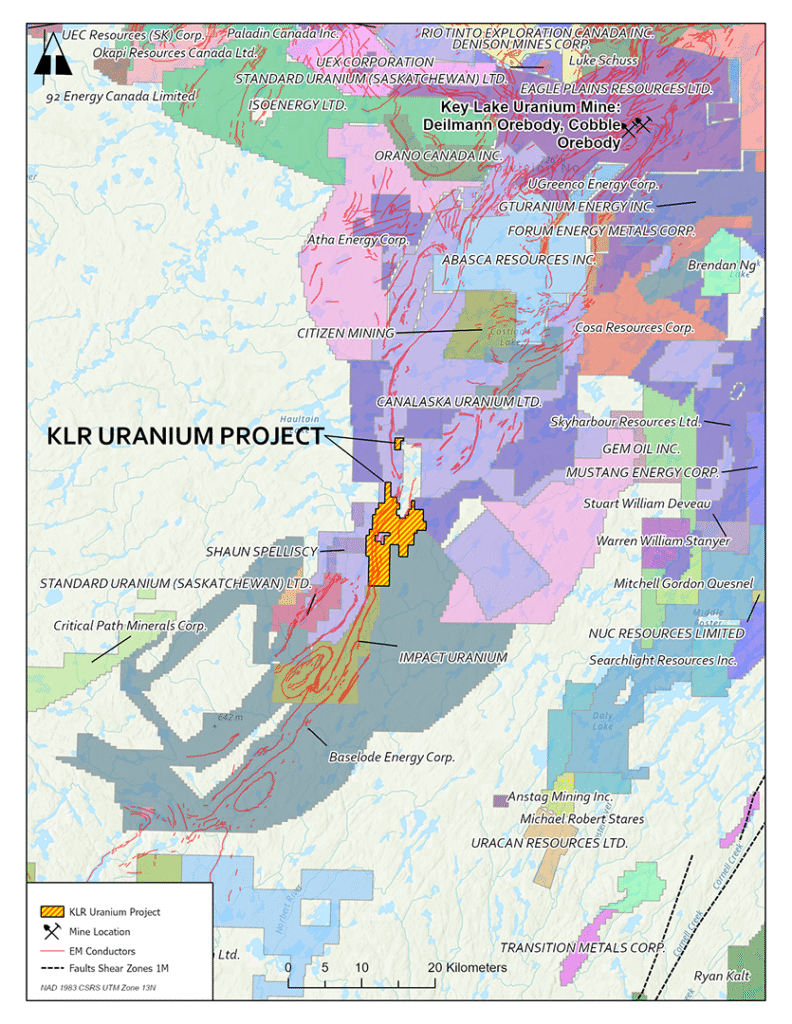
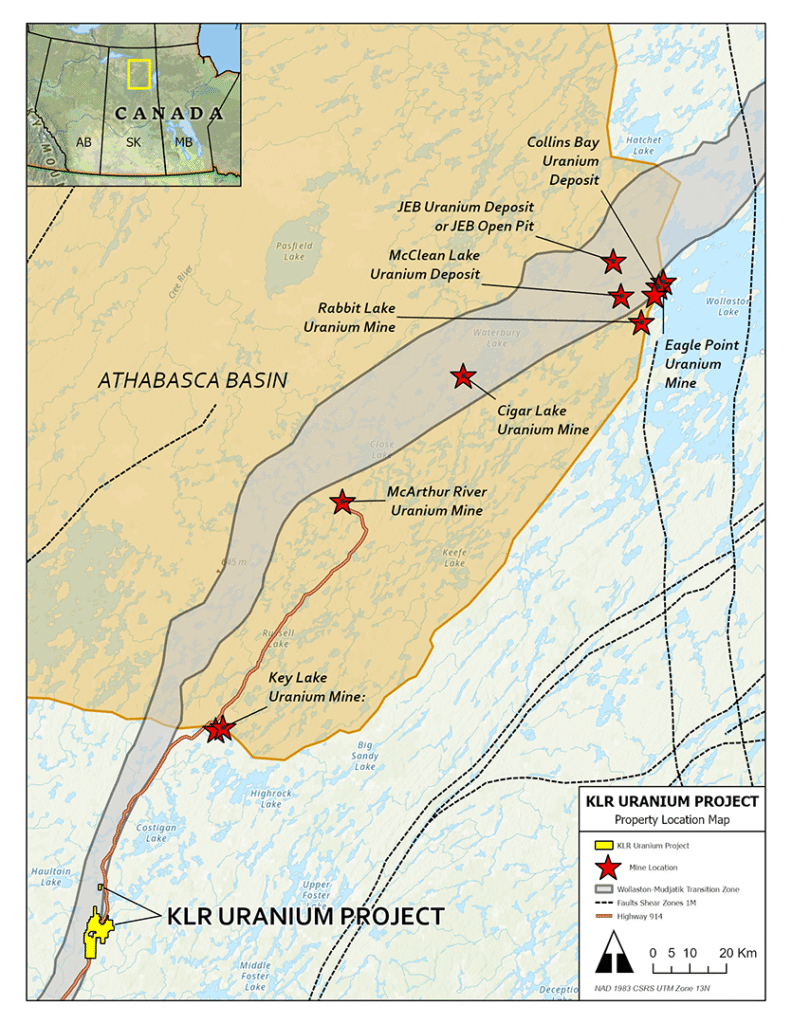
The KLR Uranium Project covers an area of approximately 5,521 hectares along the Key Lake Road, ~90km south of Cameco’s Key Lake Mine and mill, where over 209 million pounds of uranium were produced between 1983 and 20021. The property lies almost entirely within the Wollaston Mudjatik Transition Zone (WMTZ), the prolific structural corridor that also hosts the Key Lake, Cigar Lake, and McArthur River uranium deposits.
Access to the project is excellent via provincial highway 914, which bisects the property. Historical exploration work includes heliborne VTEM surveys, ground magnetic and IP surveys, prospecting, and localized drilling programs that have outlined multiple priority drill targets.
Highlights from past work² include:
DD Zone: six shallow holes drilled in 2023 intersected anomalous uranium enrichment increasing with depth, with best results of 642 ppm uranium and 0.34% nickel
Highway Zone: ground geophysics and man-portable drilling in 2015 identified a near-surface interval of 1.9% U₃O₈ over 0.29 m, suggesting the presence of high-grade mineralization.
The current exploration model, inspired by NexGen’s Arrow deposit, indicates potential for a higher-grade feeder anomaly at depth beneath the radioactive halos identified to date.
Exploration:
The company has devised a multiphase exploration strategy to leverage the wealth of historic exploration data on this project. The first phase calls for an induced polarization (IP) survey in the northern extent of the project area, where the DD Zone is located. The DD Zone, first identified by Forum Uranium, is characterized by a north-south trending fault, which is consistent with the Wollaston-Mudjatik Transition Zone (“WMTZ”), the primary geological feature controlling the uranium mineralization at the historic and producing uranium mines on the east side of the Athabasca Basin.
Previous prospecting and multiple drilling campaigns at the DD Zone has consistently identified highly anomalous uranium mineralization. The IP survey, which will consist of up to 12 line kilometers, will be used to accurately define prospective subsurface anomalies as well as the geological structural controls. Data from this survey will be used in defining potential diamond drilling targets in subsequent programs.
DD Zone Highlights:
DD-01 with values to 1250 ppm uranium over 0.25 m at 157.75 m–158 m depth¹
DD-15 with anomalous highlights values of 155 ppm nickel, 664 ppm copper and 159 ppm lead¹
DD-03, 16, 19, and 21, drilled near a rock sample with 6150 ppm uranium, recorded highlight uranium values of 761 ppm and copper, nickel, cobalt and lead values in the 200 to 300 ppm range¹
DD-07 with uranium values between 117 and 227 ppm over short intervals (0.2 m)¹
KLR23-05 and KLR23-06, which encountered a fault zone with massive pyrrhotite-pyrite and uranium values between 200 and 300 ppm. Gamma probe results in these holes included 5,800 counts per second (CPS), 8,000 CPS, and 10,300 CPS.³
Backpack drill hole KLR 15-37 with a uranium high of 1.57% over 4 cm. 6 core samples over 1,000 ppm were drilled in the area of interest during the 2015 program.²
Sources:
- Fall 2007 and Winter 2008 Drilling Report Key Lake Road Project dated June 2008 by B. Tan and K. Wheatley for Forum Uranium Corporation.
- Technical Report on the Key Lake Road Property dated 2016-Nov-21 by E. Harrington for Broome Capital Corp.
- 2023 KLR Drill Program Summary Feb 8 to Mar 20, 2025.
Tim Henneberry, Professional Geoscientist, is the designated Qualified Person as defined by National Instrument 43-101. He is responsible for, and has reviewed and approved, the scientific and technical information contained on this website.